
Why North Campus Is the Single Biggest Real Estate Demand Driver in Kamla Nagar
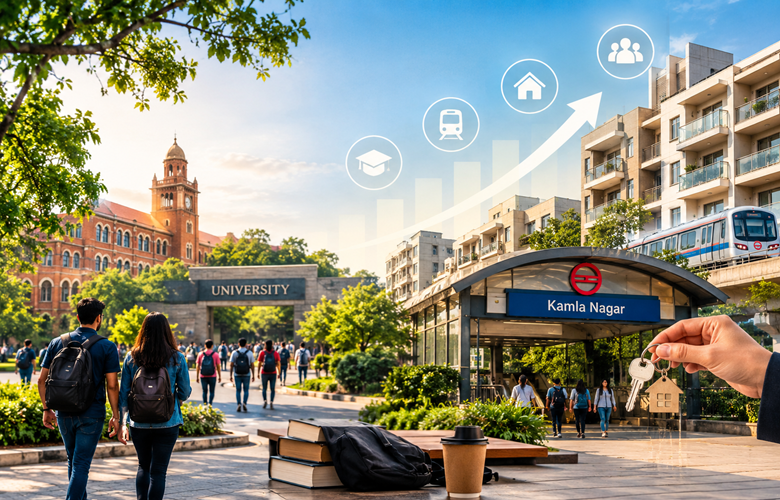
Property Demand in Kamla Nagar sits directly adjacent to Delhi University’s North Campus, one of India’s largest and most-attended public university clusters, with over 1,14,494 undergraduate students enrolled across 91 colleges and only 4,577 hostel beds to accommodate them. That structural gap between enrolment and institutional housing has kept private residential demand in North Delhi elevated for decades and is now accelerating with the arrival of Elevate Delhi 7, the landmark luxury redevelopment of the 10-acre Birla Cotton Mills site in Kamla Nagar, bringing the first large-format high-rise residential supply this micro-market has seen in a generation.
The North Campus Effect – How a University Shapes a Property Market
Most buyers evaluate a neighbourhood by its metro connectivity, schools, and shopping. Kamla Nagar checks all of those. But it has one additional engine that most other North Delhi pockets simply don’t: the perpetual housing demand created by Delhi University’s North Campus, located right on its eastern edge.
Delhi University is not a seasonal institution. It runs 12 months a year – undergraduate programmes, postgraduate courses, research departments, law school, evening college, and a large permanent faculty and administrative workforce. Each cohort feeds into the rental market around Vishwavidyalaya, GTB Nagar, and Kamla Nagar the moment it arrives, and exits the next batch in.
The numbers confirm the pressure. Delhi University has more than 2.5 lakh students across campuses, while total hostel capacity sits at around 9,000 beds. For North Campus specifically, over 1,14,494 undergraduate students are enrolled across 91 colleges against 4,577 institutional hostel beds. The shortfall is not a temporary policy gap – it has persisted for years, consistently pushing students into private rentals in the surrounding neighbourhood.
That demand floor keeps Kamla Nagar residential absorption steady, regardless of how the broader NCR market cycles.
Why the Hostel Deficit Is a Long-Term Residential Investment Signal
When a neighbourhood’s rental demand is anchored to an institution – not a single company, not a single project, not a single metro corridor – it becomes structurally more resilient. Companies relocate. Projects get completed. Metro corridors mature and spread demand outward. Universities do not move.
Delhi University’s North Campus has been at the same location since 1922. The colleges around it – Miranda House, Hindu, Hansraj, Ramjas, Kirori Mal, St. Stephen’s, SRCC, Lady Shri Ram’s affiliate institutions – are among the most competitive to enter in India. Their enrolment does not shrink.
Monthly rents for a single room in Kamla Nagar rose from around Rs 12,000 to Rs 18,000 between 2022 and 2024, a 50 percent increase in just 2 years, driven directly by this mismatch between student population and available housing. That rental appreciation is not hypothetical. It was recorded and reported across property platforms serving the area.
For a residential investor, persistent rental pressure in a micro-market means two things: low vacancy risk on rental units and consistent floor support under property values. Both are visible in Kamla Nagar today.
Who Rents and Who Buys, in the North Campus Belt
Property Demand in Kamla Nagar extends beyond student accommodation. A university of Delhi University’s scale employs a permanent faculty and administrative workforce that also needs housing near campus. Senior faculty, associate professors, department heads, and administrative officers all look for quality residential options within a reasonable commute of North Campus.
Beyond the university, the area draws professionals at All India Institute of Medical Sciences affiliates, teaching hospitals, coaching institutes around Mukherjee Nagar, and government employment hubs at the Secretariat and Civil Lines. None of these demand sources is going away.
The buyer profile for the first large-format luxury project in this micro-market, Elevate Delhi 7 Kamla Nagar, is not a student renting a PG. It is the parent buying a home for a child in college, the senior academic who wants to live 10 minutes from the department, the Delhi-rooted professional family that never wanted to move to Gurugram but had no quality high-rise option until now, and the NRI investor who went to North Campus and still has a connection to the neighbourhood.
That buyer profile does not exist in isolation. It is created by North Campus.
Connectivity That Works for Every Demand Segment
One reason North Campus anchors demand so effectively in Kamla Nagar is that the area’s connectivity serves every segment of the demand pyramid simultaneously.
The Yellow Line of the Delhi Metro links Vishwavidyalaya and GTB Nagar stations, both within walking distance of Kamla Nagar, to the rest of Delhi in under 30 minutes. Connaught Place is roughly 4 stops away. Chandni Chowk, the secretariat belt, and South Delhi’s Hauz Khas and Saket nodes are all accessible on a single metro line.
The Red Line at Pul Bangash extends that reach further, connecting to Kashmere Gate interchange and the city’s eastern corridors. The Outer Ring Road and GT Karnal Road give residents direct access to road-based routes north toward the airport and south toward the expressways.
Kamla Nagar itself is walkable. The market, banks, medical facilities, and college campuses are all within 10 to 15 minutes on foot from most parts of the neighbourhood. That walkability is a premium not replicated in greenfield NCR corridors that require a car for every errand.
For a luxury residential project in this context, connectivity is not a feature to be engineered. It already exists and serves residents across every age group, profession, and daily pattern.
The Supply Side: Why North Delhi Has Had Almost No Luxury Inventory
The demand story for North Delhi is strong and well-documented. What makes it a real estate investment opportunity rather than just a demographic observation is the supply picture, or the absence of one.
North Delhi has been dominated for decades by builder floors, plotted redevelopments, and older apartment stock. Kamla Nagar, Civil Lines, Model Town, and Mukherjee Nagar have seen demand grow steadily without the large-format, amenity-complete residential supply that Gurugram and Noida have received in the same period.
The reason is simple: land. Central Delhi parcels of any meaningful size are rare, and development approvals in a dense, established neighbourhood are harder to navigate than greenfield corridors. Most developers who wanted to build at scale chose the path of least resistance and went to the suburbs.
That structural supply deficit is exactly what makes a 10-acre parcel like the Birla Cotton Mills site at Kamla Nagar so significant. It is not just a project. It is the first opportunity in a generation for buyers who want to live in central North Delhi in a new, modern, amenity-complete home, without accepting a resale flat in an ageing building or moving to a distant suburb.
Delhi NCR’s residential market recorded a 17.6 percent year-on-year rise in average housing prices in Q1 2026 according to PropEquity data, with new supply growing 28.6 percent and sales rising 11.4 percent. The luxury segment has consistently led that appreciation, and Delhi city properties have outperformed the broader NCR average precisely because of constrained central supply.
What Elevate Delhi 7 Represents for the Kamla Nagar Property Market
Elevate Delhi 7 in Kamla Nagar is the first high-rise luxury residential development to emerge from the Birla Cotton Mills site, a 10-acre parcel that has sat at the centre of North Delhi’s real estate conversation for years. The project brings together Conscient Infrastructure, the global firm Hines (in its first-ever Delhi residential entry), Texmaco Infrastructure and Holdings Ltd under the Adventz Group, and institutional capital through HDFC Capital.
The developer combination matters because each partner brings something the others do not. Conscient has domestic delivery credibility. Hines brings international design and execution standards. Adventz is the landholding entity. HDFC Capital provides institutional capital assurance. The four-party structure signals how seriously the Kamla Nagar opportunity is being taken at a Pan-India institutional level.
For buyers evaluating the North Delhi property market, the project’s significance is not just about the apartments themselves. It is about what the project does to the broader micro-market. A branded, large-format, internationally backed luxury development creates a new pricing benchmark for the neighbourhood, attracts further institutional interest, and validates central Delhi as a serious luxury residential destination.
Cushman & Wakefield’s Market Beat reports have flagged Kamla Nagar high-street rentals rising notably through 2025, placing it among the region’s better-performing retail micro-markets. That retail rental growth signals strong footfall, strong purchasing power in the area, and the commercial confidence that typically precedes residential appreciation.
The Investor Case: Steady Demand, Scarce Supply, Improving Quality
Three things need to align for a residential micro-market to deliver consistent investment returns: persistent demand, constrained supply, and improving product quality. Kamla Nagar currently checks all 3.
Demand is persistent and multi-layered. The university ensures a rental floor. The professional and established-family buyer cohort ensures ownership demand. Institutional developer entry ensures the market can now attract higher-end buyers.
Supply is constrained. Central Delhi parcels of this scale do not appear regularly. Once this development is built, the next comparable opportunity in the same micro-market could be a decade away.
Product quality is improving. The arrival of a globally backed project resets buyer expectations for what is possible in Kamla Nagar. Once expectations shift, they don’t go back, which means the entire neighbourhood’s pricing trajectory changes.
Delhi NCR recorded a 24 percent year-on-year increase in housing prices in Q3 2025, according to ANAROCK data, the highest across India’s 7 major real estate markets. The luxury segment accounted for over 70 percent of new supply in that quarter. Kamla Nagar’s first luxury high-rise enters that market context with a demand profile that most greenfield locations would need to engineer from scratch.
Living Near North Campus: The Daily Quality of Life Case
Beyond the investment case, North Campus proximity is a genuine quality-of-life driver for residents. The tree-lined streets of the Delhi University belt, Mall Road, Chhatra Marg, and the Ridge Road edges offer a greenery density that central Delhi rarely provides. The Ridge forest to the east of Kamla Nagar gives the neighbourhood a natural boundary that keeps development pressure from its eastern side.
Daily amenities within Kamla Nagar and immediately adjacent Civil Lines include AIIMS-affiliated specialty clinics and the Hindu Rao and RML hospital networks. Schools including St. Xavier’s Sec 8 block, Delhi Public School branches, and Springdales are within 10 to 15 minutes. The Kamla Nagar Market itself, one of Delhi’s most complete high-street retail destinations, is on the project’s doorstep.
For a family making a long-term home purchase decision, the combination of metro connectivity, medical infrastructure, school proximity, retail access, and the cultural energy of the North Campus belt adds up to a livability argument that most newer NCR locations simply cannot replicate. Those locations need 15 years to develop what Kamla Nagar already has.
Read more blogs: https://www.elevatedelhi7.com/blog/
Frequently Asked Questions
Why does North Campus increase Kamla Nagar property demand?
Delhi University’s North Campus enrolls over 1,14,494 undergraduate students across 91 colleges with only 4,577 hostel beds available. That permanent, year-round mismatch forces thousands of students and university staff into the private rental market around Kamla Nagar, creating a demand base that never fully empties regardless of the economic cycle.
Is Kamla Nagar a good area to buy property for long-term investment?
Kamla Nagar has persistent rental demand from the university ecosystem, constrained new supply due to central Delhi’s land scarcity, and direct metro access on the Yellow Line. With the arrival of the first large-format luxury project on the Birla Cotton Mills site, the area is also seeing its first product-quality upgrade in a generation, all conditions that support long-term capital appreciation.
Which metro stations serve Kamla Nagar?
Vishwavidyalaya and GTB Nagar metro stations on the Yellow Line are the closest, both within walking distance of Kamla Nagar. Pul Bangash on the Red Line is also nearby, giving residents access to two metro lines and multiple interchange nodes across Delhi.
What is the significance of the Birla Cotton Mills site for North Delhi real estate?
The 10-acre Birla Cotton Mills site in Kamla Nagar is one of the largest single residential development parcels to open up in central Delhi in decades. Its redevelopment introduces the first large-format, amenity-complete luxury residential supply to North Delhi’s Kamla Nagar micro-market, setting a new benchmark for premium living in the area.
Who are the developers behind Elevate Delhi 7 in Kamla Nagar?
The project is a joint venture involving Conscient Infrastructure, global real estate firm Hines (making its first-ever Delhi residential entry), Texmaco Infrastructure and Holdings Ltd under the Adventz Group, and HDFC Capital as the institutional capital partner.
How has Delhi NCR’s luxury housing market performed recently?
According to PropEquity data, Delhi NCR recorded a 17.6 percent year-on-year rise in average housing prices in Q1 2026, with the luxury segment consistently leading price appreciation. In Q3 2025, ANAROCK reported a 24 percent year-on-year price increase, the highest among India’s 7 major real estate markets with over 70 percent of new supply falling in the premium or luxury category.
Elevate Delhi 7, Kamla Nagar
3 and 4 BHK apartments by Conscient Elevate on a 10.8 acre site in North Delhi, planned with 6 towers and 900 residences.
View the project pageRelated reading
End-Use vs Investment: Who Should Consider Premium Homes in North Delhi?
Premium homes in North Delhi suit two kinds of buyers, and they shouldn’t buy the same way. A family gets the most from a 3 BHK or 4…

Why Institutional Developers Are Entering North Delhi’s Residential Market
Large corporate and global developers are entering the North Delhi Residential Market because the few large residential sites left inside the city belong to old institutions, and only…