
Why Investors Are Watching Kamla Nagar: North Delhi’s Rare Mill-Site Reset
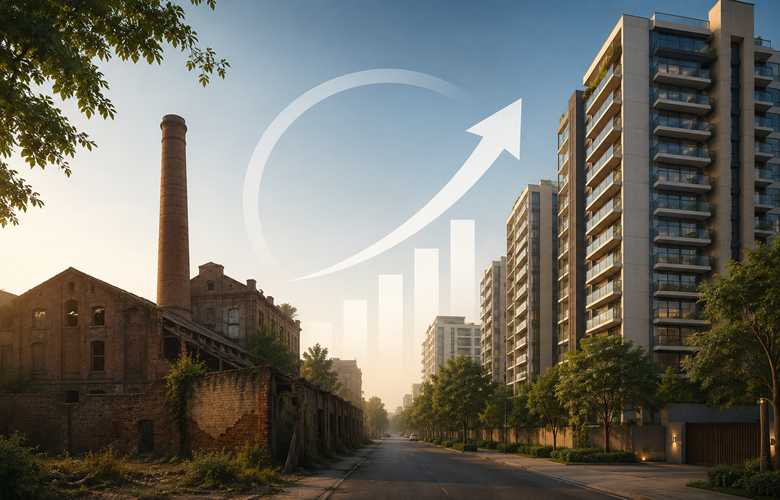
Delhi-NCR was the sharpest-moving major housing market in the country last year. Average residential prices across the region climbed roughly 23% in 2025 from about ₹7,550 to nearly ₹9,300 per sq. ft. Outpacing every other top-seven city, according to ANAROCK Research. That single figure explains why a quiet stretch of North Delhi has moved onto investor radars this year.
The trigger is a 10-acre parcel in Kamla Nagar: the former Birla Cotton Mills site, now being redeveloped into roughly 3 million square feet of condominiums and retail. What makes it unusual is not the marble in the lobby; it is the land. Central and North Delhi almost never release contiguous sites at this scale; most premium housing here is assembled by demolishing bungalows one plot at a time. When an established micro-market gets its first organised high-rise supply in years, the interest has less to do with the brochure than with basic scarcity.
The land is the story
Kamla Nagar has been a recognizable Delhi address for a hundred years, a university anchor, a market street, a place people already know how to place on a map. The mill’s closure left a rare, contiguous gap in the middle of it. Held for over a century by the Adventz Group’s Texmaco Infrastructure, the site was acquired for redevelopment through a joint venture facilitated by Cushman & Wakefield, with an estimated development value of ₹8,000-9,000 crore, as reported by news agency PTI.
The pricing context matters. Kamla Nagar’s existing stock trades at roughly ₹10,300 per square foot against a wider Delhi average closer to ₹18,400, per Square Yards’ locality data, a gap that partly reflects the absence, until now, of organized high-rise product. The residential-led project on the site, Elevate Delhi 7, pairs a US-based global developer with a domestic builder that has handed over more than 12,000 homes across Delhi-NCR, Dehradun and Goa, alongside private-equity backing. For investors, that combination of rare land, established locality, and institutional capital is the part that is genuinely difficult for a future launch to copy.
The rental engine next door
Location does most of the heavy lifting here. Delhi University’s North Campus is less than a kilometer away, and the demand-supply mismatch around it is structural: the university enrolls close to two lakh students against only about 9,000 hostel seats, according to 99acres. That gap has kept Kamla Nagar’s rental market busy for decades, historically through paying-guest and shared-flat formats.
The yield backdrop is favourable too. Delhi records a gross rental yield of 5.81%, the highest among India’s major metros and above the national average of 5.09%, per data compiled by Global Property Guide from MagicBricks. Organised high-rise supply could widen the tenant profile beyond students to visiting faculty, professionals, and corporate lets, the kind of tenancy that tends to be steadier and better-priced than a single-room PG.
Why is the money moving upmarket?
The Kamla Nagar story sits inside a national one. India’s housing demand has tilted decisively toward the top end: premium homes priced above ₹1 crore accounted for roughly 71% of sales in the top cities in Q1 2026, JLL India reported, and Delhi-NCR led the country on new launches. Knight Frank’s Wealth Report 2026 reported that Delhi’s prime residential prices rose 6.9% year-on-year, lifting the city to 17th on its global PIRI 100 index.
Policy has helped. The Reserve Bank of India cut its repo rate to 5.25%, lowering borrowing costs at the same moment institutional money flowing into real estate investment in India crossed USD 7.5 billion in 2025, and NRI participation in premium purchases has climbed from single digits a decade ago toward an estimated 18-20% this year. Homes tied to internationally recognized developers have tended to command a 20-35% premium over comparable non-branded stock, which is one reason a global operator’s first Delhi residential project warrants a second look. Readers tracking the micro-market can follow Elevate Delhi 7’s Kamla Nagar market notes for locality-level updates.
What the experts and the caveats say
“The land is the moat here. A contiguous ten-acre site inside an established locality can’t be manufactured by the next launch, which is exactly why execution, not the address, is the variable to watch.”
The market view is not one-sided. Cushman & Wakefield, which advised on the transaction, noted that Delhi has seen limited premium Grade-A residential supply in recent years, framing the redevelopment as a potential market-mover rather than a certainty. And there are real caveats. At the pre-launch stage, the project’s RERA registration was still pending, and this particular joint venture had no completed Delhi high-rise to point to as a delivery precedent. Heritage-site redevelopment can lead to approval and structural-survey delays, and ultra-premium ticket sizes can push effective rental yields below the locality’s headline average. Prudent buyers verify the RERA number and read the possession clauses before committing beyond a refundable expression of interest.
The bottom line
Whether Kamla Nagar’s mill-site redevelopment becomes a genuine repricing event or simply a well-located launch will depend on two things a brochure cannot promise: how disciplined the delivery timeline stays, and whether the premium tenant base actually shows up once the towers are complete. The scarcity argument is real and hard to replicate. The execution argument is still being written. For investors, the discipline lies less in chasing first-mover pricing and more in verifying the registration, reading the fine print, and watching how the first tower is delivered. North Delhi has waited a long time for organised luxury supply; the next eighteen months will show whether this is the reset the market has been pricing in, or a story that still needs its second act.
Read more: https://www.elevatedelhi7.com/blog/elevate-delhi-7-vs-sobha-city-gurgaon-buyers-comparison/
Frequently Asked Questions
Why are investors looking at Elevate Delhi 7 in Kamla Nagar?
The pull is a combination of scarcity and market timing. Central and North Delhi rarely release large, contiguous land; the ten-acre former Birla Cotton Mills site brings organised high-rise supply to an established locality for the first time in years. That arrives just as Delhi-NCR led India’s price growth in 2025 (up roughly 23%, per ANAROCK) and borrowing costs eased after the RBI cut its repo rate to 5.25%.
Where exactly is the project located?
It sits in the heart of Kamla Nagar, North Delhi, on the former Birla Cotton Mills land. Delhi University’s North Campus is under a kilometre away and the Vishwavidyalaya metro station (Yellow Line) is roughly 1.2 km out, placing it inside one of the capital’s established educational and commercial pockets.
Who is developing Elevate Delhi 7?
The redevelopment is a joint venture: Texmaco Infrastructure (Adventz Group) owns the land, with Hines, a US-based global real estate firm, and Conscient Infrastructure handling development, and HDFC Capital providing private equity backing. Cushman & Wakefield facilitated the joint development agreement, per PTI.
What makes the Kamla Nagar location attractive for rental income?
Proximity to Delhi University drives structural rental demand the university enrolls close to two lakh students against about 9,000 hostel seats (99acres), so nearby areas absorb the overflow. Delhi’s gross rental yield of 5.81% is also the highest among major Indian metros, above the 5.09% national average, per Global Property Guide data drawn from MagicBricks.
What are the prices and unit sizes?
At the time of writing, pricing and floor sizes were in a “coming soon” / expression-of-interest phase, positioned as a premium development. For context, Kamla Nagar’s existing stock trades near ₹10,300 per square foot against a Delhi average closer to ₹18,400 (Square Yards). Prospective buyers should treat any pre-launch figure as indicative until the official price list is released.
Is there a first-mover advantage for early investors?
Potentially. As one of the first organised luxury high-rises in a land-starved part of North Delhi, early-stage buyers enter ahead of formal launch pricing. That said, actual price movement depends on the launch, market conditions, and delivery; no specific gain can be guaranteed, and first-mover positioning is a thesis, not a promise.
How does this compare with buying in Gurugram or Noida?
Gurugram and Noida offer deeper organised-luxury supply and more delivery precedents, which some investors prefer for liquidity. North Delhi’s pitch is different: an established, centrally located micro-market with almost no comparable new supply. The trade-off is scarcity and location versus a longer, less-proven delivery track record in this specific format.
What are the main risks investors should weigh?
Four stand out: the RERA registration was still pending at the pre-launch stage; the joint venture has no completed Delhi high-rise as a delivery precedent; heritage-site redevelopment can invite approval or structural-survey delays; and ultra-premium ticket sizes can compress effective rental yields below the locality’s headline figure. Verifying the RERA number is the first due diligence step.
Do branded or global-developer residences actually hold better value?
Across several markets, residences tied to internationally recognized developers have commanded a 20–35% premium over comparable non-branded stock and have shown steadier resale support. India is expected to supply a growing share of global branded-residence stock this decade. The premium is real but not automatic; it depends on execution and the credibility the brand maintains locally.
Why is North Delhi seeing this shift now?
Demand has moved upmarket nationally; premium homes above ₹1 crore accounted for around 71% of sales in the top cities in Q1 2026, while Delhi-NCR led launches, and Knight Frank recorded prime prices in Delhi up 6.9% year-on-year. Combine that with cheaper credit, rising NRI participation and a genuinely rare land parcel, and North Delhi’s long-quiet luxury segment finally has a catalyst.
Elevate Delhi 7, Kamla Nagar
3 and 4 BHK apartments by Conscient Elevate on a 10.8 acre site in North Delhi, planned with 6 towers and 900 residences.
View the project pageRelated reading

End-Use vs Investment: Who Should Consider Premium Homes in North Delhi?
Premium homes in North Delhi suit two kinds of buyers, and they shouldn’t buy the same way. A family gets the most from a 3 BHK or 4…

Why North Campus Is the Single Biggest Real Estate Demand Driver in Kamla Nagar
Property Demand in Kamla Nagar sits directly adjacent to Delhi University’s North Campus, one of India’s largest and most-attended public university clusters, with over 1,14,494 undergraduate students enrolled…