
Elevate Delhi 7 vs South Delhi Luxury Apartments: Better Value in 2026?
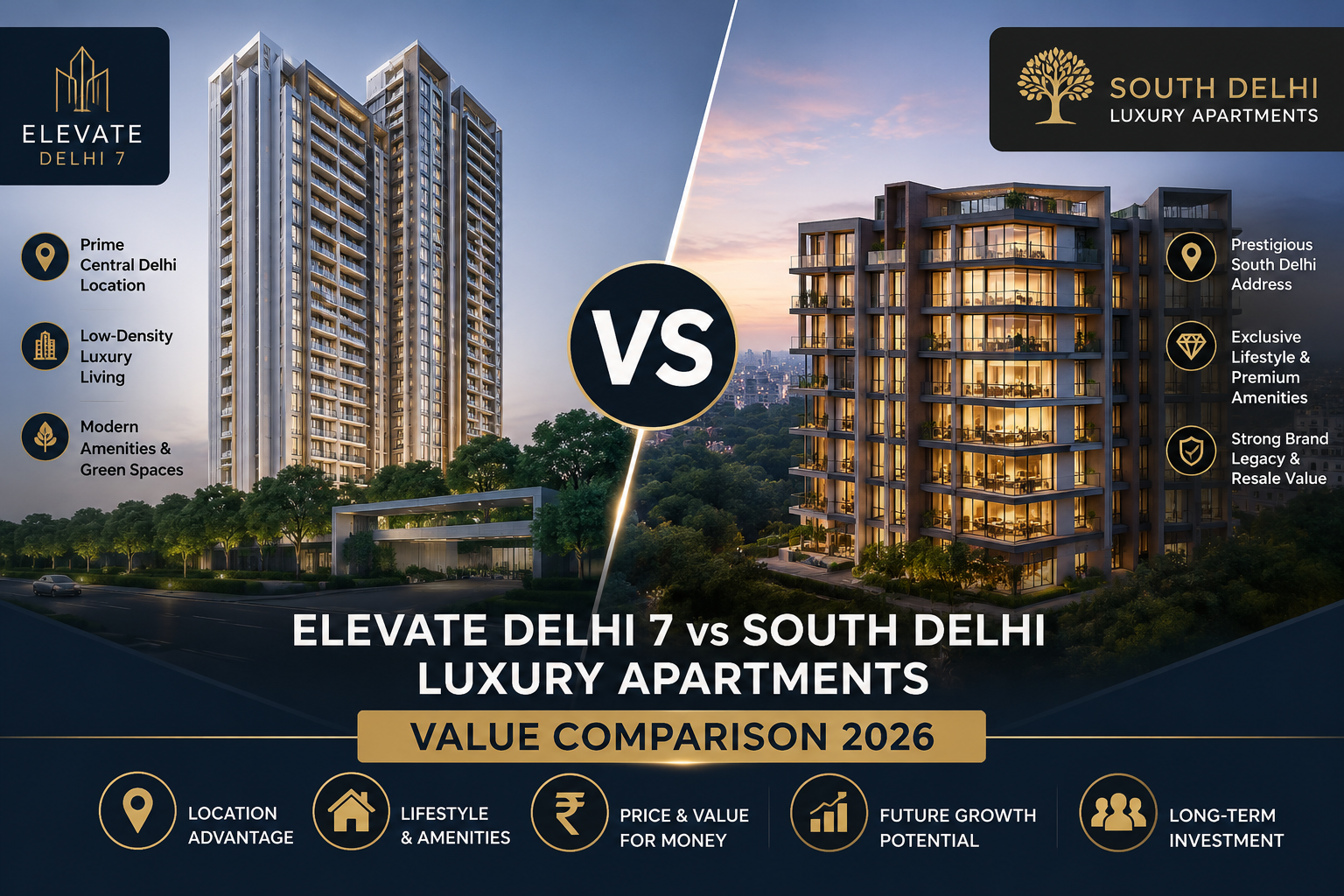
On published Q1 2026 figures, South Delhi luxury floors work out to roughly ₹43,000 to ₹78,000 per sq.ft. Elevate Delhi 7 carries an unofficial pre-launch estimate near ₹28,000 per sq.ft. Kamla Nagar is cheaper per foot. South Delhi gives you freehold land, nil GST, and possession today.
- South Delhi’s published averages imply ₹43,000–₹78,000 per sq.ft. higher than the rates usually quoted in listing copy.
- Elevate Delhi 7 has no Delhi RERA number and no declared price. The ₹28,000 figure in circulation is a broker estimate.
- Most South Delhi builder floors are placed legally outside RERA. The 10-acre Kamla Nagar project cannot.
- GST is the hidden swing factor: 5 percent on under-construction, nil on a completed or resale floor.
- One market has the price but no regulator. The other has the regulator but no price.
Key Takeaways
- Category B South Delhi floors of 2,500 sq.ft. averaged ₹10.75 crore in Q1 2026; Category A averaged ₹19.5 crore. Golden Growth Fund, via Business Standard, May 2026.
- Divided out, that is about ₹43,000 per sq.ft. in Category B and ₹78,000 in Category A on built-up area, not RERA carpet.
- Category B colonies grew 23-32 percent year on year; Category A grew 14-22 percent.
- Section 3(2)(a) of the RERA Act, 2016 exempts projects on land up to 500 sq m or with eight units or fewer, which covers most South Delhi floors.
- Under-construction GST is 5 percent with no input tax credit; nil once a completion certificate is issued, and nil on resale.
- Texmaco, Hines, Conscient and HDFC Capital announced the 10-acre, 3-million-sq-ft Kamla Nagar development in January 2025 (PTI).
The Numbers Nobody Puts Side by Side
Most comparisons of these two options quote a per-square-foot figure for one side and a lifestyle adjective for the other. That is not a comparison. It is a brochure with a table in it.
So start with what has actually been published. Golden Growth Fund’s Q1 2026 survey of the South Delhi floor market, reported by Business Standard in May 2026, gave absolute ticket sizes rather than rates. Divide them out and the picture shifts.
| Metric | Elevate Delhi 7, Kamla Nagar | South Delhi Category B | South Delhi Category A |
|---|---|---|---|
| Format | High-rise condominium apartment | Builder floor on freehold plot | Builder floor on freehold plot |
| Published average ticket | None declared | ₹10.75 Cr (2,500 sq.ft.); ₹16.5 Cr (3,200 sq.ft.) | ₹19.5 Cr (2,500 sq.ft.); ₹40 Cr (6,000 sq.ft.) |
| Implied ₹ per sq.ft. | ₹28,000 (unofficial estimate) | ₹43,000 to ₹51,600 | ₹66,700 to ₹78,000 |
| Q1 2026 YoY growth | No price history | 23-32 per cent | 14-22 per cent |
| Area basis | RERA carpet, once declared | Built-up / super | Built-up / super |
| GST | 5 per cent, no input credit | Nil on resale or post-CC | Nil on resale or post-CC |
| RERA cover | Applied; no number allotted | Usually exempt, s.3(2)(a) | Usually exempt, s.3(2)(a) |
| Land interest | Undivided share in common land | Proportionate freehold share | Proportionate freehold share |
| Possession | Phased, talked about 2030-31 | Immediate | Immediate |
Two things fall out of that arithmetic, and both are inconvenient for the usual sales pitch.
The first is that South Delhi’s real per-foot cost sits well above the ₹32,000-₹35,000 band that circulates in listing copy. An average of ₹10.75 crore for 2,500 sq.ft. is ₹43,000 a foot. The 3,200 sq.ft. segment, which posted the sharpest 32 per cent rise, averages closer to ₹51,600.
The second is that Elevate Delhi 7 Kamla Nagar has no equivalent number. It has an estimate. Those are different things, and the difference is the whole point of this comparison.
Why the Per-Square-Foot Comparison Breaks
Three reasons, and every one of them cuts against the headline discount.
Area basis. South Delhi floor areas are quoted as built-up or super. When Delhi RERA registers the Kamla Nagar project, the declared price will attach to carpet area, a materially smaller number for the same home. Setting an unofficial super-area rate against a built-up rate and calling the gap a discount is arithmetic, not analysis.
All-in versus base. The ₹28,000 figure in circulation is described as all-inclusive, bundling GST, parking bays and club membership. The base rate is talked about nearer ₹24,000. South Delhi floor prices are quoted as deal value, with statutory costs stacked on top. Compare like for like or do not compare.
Nothing is declared. As of the most recent public check, the consortium had applied for Delhi RERA registration and no number had been allotted. Every rate you can find is an estimate produced by somebody who wants to sell you something. Read our Kamla Nagar price and floor plan for how those estimates were built.
The RERA Gap That Belongs in Every Comparison Table
Here is the part almost no comparison page mentions, and it matters more than any amenity list.
Section 3(2)(a) of the Real Estate (Regulation and Development) Act, 2016 exempts a project from registration where the land does not exceed 500 square metres, or the number of apartments does not exceed eight. Delhi’s authority reads either threshold as triggering registration cross one, and you must register.
Now apply that to a South Delhi builder floor. A 300-square-yard plot is roughly 251 square metres. Stilt plus four floors gives four or five apartments. Both thresholds cleared, comfortably. No registration. No regulator-declared completion date. No penalty clause anybody enforces on your behalf. No escrow account.
That is not automatically bad. A finished floor you can walk through, tap the walls of and inspect for seepage carries far less execution risk than a drawing. But if something is wrong, your remedy is a civil suit, not a complaint to an authority.
The Kamla Nagar project is situated on the other side of that line. 10 acres and 100 of units make registration mandatory, which means a declared carpet area, a declared handover date and a declared penalty for missing it. HDFC Capital’s stated role is financial governance. That is the trade in one sentence: you gain the regulatory architecture, and you give up the ability to inspect what you are buying. Verify the registration yourself at rera.delhi.gov.in before any payment beyond a refundable expression of interest.
“In South Delhi you are buying land and taking title risk without a regulator. In Kamla Nagar you are buying a schedule and taking execution risk with one. Both are defensible. Confusing the two is what costs people money.”
GST, Stamp Duty and the Line Item That Moves ₹45 Lakh
| Statutory cost | Elevate Delhi 7 (under construction) | South Delhi floor (ready or resale) |
|---|---|---|
| GST | 5 per cent, no input tax credit | Nil |
| Stamp duty | 6% male / 4% female / 5% joint | 6% male / 4% female / 5% joint |
| Registration fee | 1 per cent | 1 per cent |
| MCD transfer duty (above ₹25 lakh) | 1 per cent | 1 per cent |
| Indicative all-in, male buyer | About 13 per cent of value | About 8 per cent of value |
Under-construction residential property outside the affordable bracket attracts 5 per cent GST, and you cannot claim input credit against it. Once a completion certificate is issued, GST falls away. Resale never attracts it at all.
On a ₹9 crore purchase, that is roughly ₹45 lakh of tax a South Delhi resale buyer simply never pays. It is the largest single structural cost difference between the two options, and it quietly closes a good part of the per-foot gap that makes Kamla Nagar look cheap.
Everything else is symmetrical. Stamp duty is 6 per cent for male buyers, 4 per cent for female buyers, 5 per cent for joint ownership, plus 1 per cent registration and, above ₹25 lakhs, a 1 per cent municipal transfer duty.
What You Actually Own
A South Delhi floor conveys the built structure plus an undivided proportionate share of freehold land. That share is what redevelopment value rests on, and it is why a floor on a 500-yard plot out-appreciates a better-finished floor on a 200-yard plot in the same colony. Construction depreciates. Land does not.
An apartment in a ten-acre condominium conveys the unit plus an undivided share of common areas. You cannot redevelop it on your own initiative. You also cannot be dragged into a rebuild you never wanted, and you do not carry structural liability by yourself. Our buyer and investor guide sets out which profiles that suits.
Growth, Yield and the Exit Question
South Delhi has the record. Category B colonies up 23 to 32 per cent, Category A up 14 to 22 per cent, in a quarter when the wider NCR market was cooling. Roughly 18,500 plots sit across the 42 Category A and B colonies, with redevelopment potential put at ₹6.5 lakh crore. That is a market with depth, liquidity and decades of comparable transactions behind every quoted price.
Kamla Nagar has the opposite: a supply vacuum. 99acres lists local builder floors in a ₹5,150 to ₹12,050 band. Square Yards puts the locality average near ₹10,300 per sq.ft. against a Delhi-wide ₹18,400. An indicative ₹28,000 is therefore close to two and a half times its own micro-market. That premium is either the price of scarcity or the price of optimism, and which one it turns out to be depends on whether the project succeeds in creating the comparable set that does not exist yet. Our Kamla Nagar market outlook tracks that question quarter by quarter.
On yield, be careful which number you are quoted. Anarock has put Delhi residential yields near 2.9 percent. Global Property Guide’s asking-rent measure put Delhi at 5.81 percent in Q2 2026, but that basket is weighted towards smaller units. Neither figure describes a ₹9 crore three-bedroom, in either market.
Infrastructure is close to a draw. Metro Phase 4 serves both: Ghanta Ghar, minutes from the Kamla Nagar site, is a station on the Magenta Line extension, while Greater Kailash-1 gets its own station on the Lajpat Nagar to Saket G-Block corridor. Neither side owns the connectivity argument.
Who Should Buy Which
- Buy in South Delhi if you need possession now, you want a freehold land share on the deed, you are sensitive to the 5 percent GST, or you are buying primarily as a store of value with rental income from month one.
- Buy at Elevate Delhi 7 if you want managed gated living with lifts, security, power backup and a clubhouse, you can wait until the end of the decade, you value institutional accountability above land title, and you are consciously underwriting North Delhi scarcity.
- Wait if you cannot yet verify a Delhi RERA number and a declared carpet-area price. There is no version of this decision where paying before registration improves your position.
What We Are Seeing Between Kamla Nagar and Greater Kailash
Two questions dominate our enquiries this quarter, and they come from the same household. The older generation asks about the land share. The younger generation asks about the lift.
That split explains the whole market. North Delhi families who have held property around Roop Nagar, Shakti Nagar and Civil Lines for three generations understand land instinctively they have watched a plot outrun every other asset they own. What they have never had locally is a building with a basement, a functioning lift lobby, security at a single gate and somebody else responsible for the pump. South Delhi buyers have had the second thing for years and pay a documented premium for the first.
The observation we keep repeating on site visits is simpler than either side expects. Nobody in Kamla Nagar is choosing between two comparable products. They are choosing between an asset class with a hundred-year local track record and an asset class with none in a location where the first class has run out of land.
“The question is never which market is better. It is whether you are being paid enough to hold the risk you are actually taking, and most buyers cannot name that risk when we ask.”
Key Takeaways
This is a choice between two risk structures, not two price tags.
- South Delhi is the priced market. Golden Growth Fund’s Q1 2026 averages imply roughly ₹43,000 per sq.ft. in Category B and ₹78,000 in Category A, with 23-32 percent and 14-22 percent annual growth, respectively.
- Elevate Delhi 7 is the unpriced market. No Delhi RERA number, no declared carpet-area rate. Treat the ₹28,000 figure as a broker estimate and nothing more.
- GST is the swing factor buyers miss. Five per cent with no input credit on under-construction stock, nil on a completed or resale floor, about ₹45 lakhs on a ₹9 crore ticket.
- Most South Delhi floors are outside RERA under Section 3(2)(a). You gain freehold land and lose the regulator. The 10-acre Kamla Nagar project reverses both.
- Verify before you pay. Check the registration number on the Delhi RERA portal, read the declared carpet area, and keep any expression of interest refundable in writing.
If the Kamla Nagar side is where you are leaning, the sensible next step is to read the full project overview and the North Delhi investment guide, then register interest so that the RERA-declared price sheet reaches you the day it is published rather than a month later.
Frequently Asked Questions
Which offers better value, Elevate Delhi 7 or a South Delhi luxury apartment?
It depends on which risk you are paid to take. Elevate Delhi 7 looks cheaper per square foot on unofficial pre-launch numbers, but you accept an undeclared price and a handover several years away. A South Delhi floor costs more per foot and delivers freehold land share, nil GST and rental income from the first month.
What is the price per sq.ft. of Elevate Delhi 7 Kamla Nagar in 2026?
No official rate exists yet. The consortium had not received a Delhi RERA number or declared pricing as of the latest public check, so every figure circulating online is a broker estimate. Unofficial pre-launch talk sits near ₹28,000 per sq.ft. all-inclusive. You should wait for the RERA-declared carpet-area price.
How much do South Delhi luxury apartments cost per square foot?
Golden Growth Fund put average Category B floors of 2,500 sq.ft. at ₹10.75 crore in Q1 2026, which implies about ₹43,000 per sq.ft. Category A averages of ₹19.5 crore for the same size imply roughly ₹78,000 per sq.ft. Those areas are built-up, not RERA carpet.
Are South Delhi builder floors covered by RERA?
Usually not. Section 3(2)(a) of the Real Estate (Regulation and Development) Act, 2016 exempts projects built on land up to 500 square meters or containing eight apartments or fewer. A typical 300-square-yard South Delhi plot carrying 4 or 5 floors clears both thresholds, so no regulator holds that builder to a timeline.
Do I pay GST on Elevate Delhi 7 but not on a South Delhi floor?
Broadly, yes. Under-construction homes outside the affordable bracket attract 5 per cent GST with no input tax credit available to you. A completed floor sold after its completion certificate, and every resale transaction, attracts nil GST. On a ₹9 crore ticket, that single distinction is worth roughly ₹45 lakhs.
What are stamp duty and registration charges in Delhi in 2026?
Delhi charges 6 per cent stamp duty for male buyers, 4 per cent for female buyers and 5 per cent for joint ownership, plus 1 per cent registration. A further 1 per cent MCD transfer duty applies above ₹25 lakhs. Duty is calculated on the higher of deal value or circle rate.
Which market appreciated faster over the last year?
South Delhi, on the only published record available. Golden Growth Fund reported Category B colonies rising 23 to 32 per cent year on year in Q1 2026, and Category A colonies rising 14 to 22 per cent. Elevate Delhi 7 has no price history, because it has not launched yet.
Is Kamla Nagar a good rental market compared with South Delhi?
Kamla Nagar carries deeper tenant volume, because Delhi University’s North Campus sits beside it, though that demand skews towards student and paying-guest budgets rather than large family homes. Anarock pegged Delhi gross residential yields near 2.9 per cent. Test any yield promise against actual three-bedroom rents, not headline city averages.
Will an Elevate Delhi 7 apartment resell as easily as a South Delhi floor?
Not at first. South Delhi floors trade in a market with decades of comparable transactions sitting behind every price quoted. Kamla Nagar has none for branded high-rise stock, so early resale value depends on the project itself creating that comparable set. Read our Kamla Nagar market outlook for the longer view.
What should I check before paying anything on a pre-launch Delhi project?
Verify the RERA registration number yourself on rera.delhi.gov.in rather than trusting a brochure or a sales deck. Confirm the declared carpet area, the possession date and the penalty clause written into your agreement. Keep any expression of interest refundable in writing, and never transfer money outside the project escrow account.
Elevate Delhi 7, Kamla Nagar
3 and 4 BHK apartments by Conscient Elevate on a 10.8 acre site in North Delhi, planned with 6 towers and 900 residences.
View the project pageRelated reading
End-Use vs Investment: Who Should Consider Premium Homes in North Delhi?
Premium homes in North Delhi suit two kinds of buyers, and they shouldn’t buy the same way. A family gets the most from a 3 BHK or 4…

Why North Campus Is the Single Biggest Real Estate Demand Driver in Kamla Nagar
Property Demand in Kamla Nagar sits directly adjacent to Delhi University’s North Campus, one of India’s largest and most-attended public university clusters, with over 1,14,494 undergraduate students enrolled…