
- Kamla Nagar: ₹10,500–25,000/sq.ft. Rentals ₹25,000-60,000/month (NoBroker Locality IQ, May 2026)
- Civil Lines: Avg ₹18,750/sq.ft. band ₹16,900-25,750 (99acres price trends)
- Model Town: ₹16,000-19,500/sq.ft. Own Yellow Line station, most family-friendly
- Hudson Lane, GTB Nagar, Mukherjee Nagar: rent-first markets, not buy lists
- Supply shift: the 10-acre Birla Cotton Mills redevelopment brings North Delhi’s first organized gated high-rise community in about three decades
Search this question, and you will get the same article 20 times over: Hudson Lane for cafés, Vijay Nagar for PGs, Mukherjee Nagar for coaching centers. Useful if you are a nineteen-year-old planning one semester at a time.
But the people typing this query in 2026 are not only students. They are parents weighing a flat purchase against four years of hostel and PG bills. Faculty tired of commuting in from another district. NRI families who studied at North Campus in the 1990s and want a foothold back in the neighbourhood. For all of them, the renter’s map is the wrong map.
This guide reads the owner’s map.
The Micro-Market Scorecard: Five Areas, One Table
Prices below are asking rates compiled from listing-portal research pages (NoBroker Locality IQ, 99acres price trends) as of mid-2026, not registered transaction values. Treat them as bands, not quotes.
| Locality | 2026 price band (₹/sq.ft. ) | Best suited for | Metro access |
|---|---|---|---|
| Kamla Nagar | 10,500-25,000 | Buyers wanting yield + market energy | Vishwavidyalaya (Yellow); Magenta extension planned nearby |
| Civil Lines | 16,900-25,750 (Avg 18,750) | Capital preservation, prestige | Civil Lines (Yellow) |
| Model Town | 16,000-19,500 | Families, long-term end use | Model Town (Yellow) |
| Hudson Lane–GTB Nagar | Rent-first market | Student renters | GTB Nagar (Yellow) |
| Mukherjee Nagar | 11,800 | Yield investors; exam aspirants | GTB Nagar / Vidhan Sabha (Yellow) |
Kamla Nagar: The Address of the Campus Built
Kamla Nagar is situated directly against North Campus, and everything about it flows from that fact. Builder floors and apartments here list between ₹10,500 and ₹25,000 per sq.ft. Premium stretches around Bungalow Road command more. The rental market is the real engine: monthly rents run ₹25,000-60,000, fed by a student and faculty population that renews itself every admission season.
The trade-offs are honest ones. Peak-hour congestion around the market circles is real, parking inside the older residential blocks is scarce, and commercial lanes press up against homes. What you get in exchange is a locality where a flat almost never remains vacant and where the biggest land parcel in central North Delhi is now being rebuilt (more on that below).
Civil Lines: North Delhi’s Old Money Belt
Civil Lines is the counterweight to Kamla Nagar’s energy. This is the bungalow-and-boulevard zone of colonial-era North Delhi, home to senior bureaucrats and old business families. Flat rates average around ₹18,750 per sq.ft. Within a ₹16,900-25,750 band, a 3 BHK apartment typically lists near ₹4-4.5 crore on 99acres.
Buy here for capital preservation and address value rather than yield. Housing stock skews toward large plots, villas, and a handful of premium apartment projects. The Yellow Line’s Civil Lines station puts North Campus one stop away.
Model Town: Where DU Families Settle
Developed in the early 1950s as one of independent India’s first planned affluent colonies, Model Town remains the most family-shaped locality on this list. Property rates run ₹16,000–19,500 per sq.ft. as of May 2026. It has its own Yellow Line metro station, the Naini Lake promenade, wider internal roads than anything closer to campus, and established schools within the colony.
For a faculty family or a buyer who wants campus access without campus noise, Model Town is usually the shortlist-topper. Is Model Town good for families? The resident profile answers that better than any brochure: it is where DU households historically end up.
Hudson Lane & GTB Nagar: Rent It, Don’t Buy It
Hudson Lane is North Campus’s café strip and its most famous student address, with GTB Nagar metro anchoring the pocket. As a lifestyle-and-rental market, it is excellent. As a purchase market, it is narrow: stock is dominated by standalone buildings and PG-format floors, and pricing behaves like a rental business, not a housing market.
Our honest read: if your horizon is a degree, rent here happily. If your horizon is ownership, look one ring outward.
Mukherjee Nagar & Vijay Nagar: The Yield Play
Mukherjee Nagar is Delhi’s civil-services coaching capital, and its property maths reflects it: entry prices around ₹11,800 per sq.ft. With 2 BHK rents near ₹28,000 a month. That ratio is why small investors like it. Vijay Nagar, wedged between campus and GTB Nagar, works the same way at student-budget rents.
Both are volume markets. Tenant churn is high, buildings are dense, and appreciation follows the broader North Delhi curve rather than leading it. Buy here for cash flow, not for the address.
Why the Ownership Map Is About to Change
Here is the structural fact behind everything above: North Delhi’s housing near the university is almost entirely builder floors and independent houses. Families who wanted a gated, lift-serviced, security-managed community had to leave the district to find one. That is why demand around North Campus never translated into modern supply, there was nothing modern to buy.
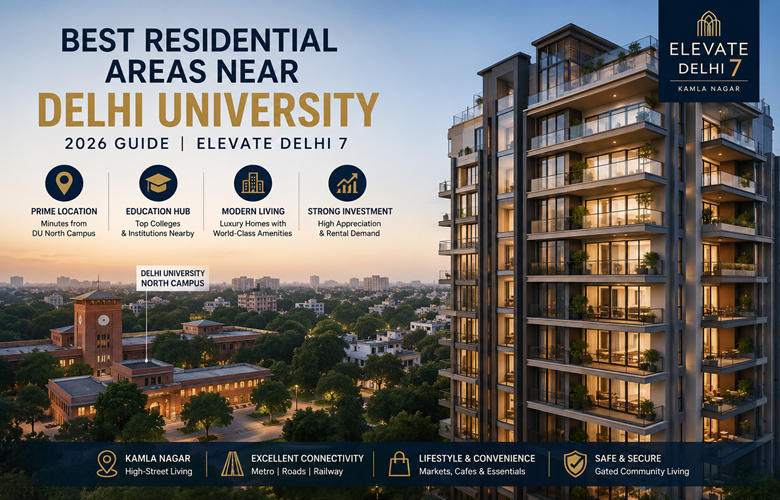
That changes with the redevelopment of the 10-acre former Birla Cotton Mills site in Kamla Nagar, Elevate Delhi 7, a consortium project by global developer Hines with Conscient Infrastructure, landowner Texmaco (Adventz Group), and HDFC Capital as financial partner. Around 3 million sq.ft. across seven high-rise towers, it is North Delhi’s first organised gated high-rise community in roughly three decades, quoting near ₹28,000 per sq.ft. with 3 BHKs indicated from ₹7.5-8 crore. RERA registration has been applied for, with the certificate expected against the NCT of Delhi authority, verify status on rera.delhi.gov.in before committing funds.
A planned Magenta Line extension station near the Ghanta Ghar side would add a second metro corridor to a belt served today only by the Yellow Line. For the localities in this guide, that is the single biggest forward-looking variable.
What We Are Seeing on the Ground Around North Campus
The inquiry mix at our desk has shifted in a way the ranking articles have not caught up with. Rental queries from students still come, as they always have. But sitting beside them now is a second stream: parents running the arithmetic of four years of hostel and PG costs against an EMI, DU alumni settled abroad asking about a foothold back in the neighbourhood they studied in, and faculty households tired of cross-city commutes.
What unites them is not budget; budgets vary widely. It is format. Nearly every purchase conversation includes the same requirements: gated entry, lifts, managed security, organised parking. And until now, the honest answer in most of North Delhi was that this format barely existed here. Buyers either compromised on a builder floor or left the district entirely, usually for Gurugram or Noida, taking their capital with them.
That is the context in which we read the Birla Mills redevelopment: less as one more project launch, and more as the first test of how much pent-up ownership demand this belt actually holds.
“North Campus has always created housing demand. It has never created housing supply. That is the gap 2026 finally starts to close.” Elevate Delhi 7 Advisory Desk
The Short Version
Match the locality to your horizon, not to a listicle.
- Buying for the long term: shortlist Kamla Nagar (₹10,500-25,000/sq.ft.) for yield and energy, Civil Lines (₹18,750/sq.ft.) for prestige, Model Town (₹16,000-19,500/sq.ft.) for family living.
- Renting for a degree: Hudson Lane, GTB Nagar, Vijay Nagar, and Mukherjee Nagar remain the value pockets; treat them as rental markets, not purchase markets.
- Verify before you pay: cross-check any project’s registration status on the RERA Delhi portal (rera.delhi.gov.in) and metro alignments on delhimetrorail.com.
- Watch the supply shift: The Birla Mills redevelopment is the first real test of organized gated housing in this belt; if the format resonates, the ownership map of North Delhi redraws around it.
If you’d like the detailed numbers on the new Kamla Nagar development, our Elevate Delhi 7 investment guide covers pricing, towers, and timelines, and you can request current floor plans from the same page.
Read more: 10 Reasons to Invest in Elevate Delhi 7 Kamla Nagar
FAQs: Living and Buying Near Delhi University
What is the best residential area near Delhi University?
The best residential areas near Delhi University are Kamla Nagar, Civil Lines, Model Town, Hudson Lane–GTB Nagar, and Mukherjee Nagar. If you are buying, Kamla Nagar and Civil Lines offer the strongest long-term value; if you are renting as a student, Hudson Lane and Mukherjee Nagar cost less and sit closer to coaching centres and campus gates.
What is the property price per sq.ft. in Kamla Nagar in 2026?
Kamla Nagar property rates in 2026 range from roughly ₹10,500 to ₹25,000 per sq.ft. for builder floors and apartments, according to NoBroker’s May 2026 locality data. Premium stretches near Bungalow Road command more. New organised high-rise supply on the former Birla Cotton Mills site is quoting around ₹28,000 per sq.ft.
Is Model Town good for families?
Yes. Model Town is one of North Delhi’s most family-friendly localities, with property rates of ₹16,000-19,500 per sq.ft. its own Yellow Line metro station, Naini Lake, wide internal roads, and established schools nearby. Many Delhi University faculty families settle here because it balances campus access with quieter, greener residential blocks.
Which is better for buying: Civil Lines or Kamla Nagar?
Civil Lines suits buyers who want prestige and larger plots; average flat rates stand near ₹18,750 per sq.ft. Bungalow-belt addresses go higher. Kamla Nagar suits buyers who want rental income and market energy, since Delhi University’s student economy keeps demand constant. For pure capital preservation, Civil Lines; for yield, Kamla Nagar.
Which areas near Delhi University are best for renting students?
Hudson Lane, GTB Nagar, Vijay Nagar, and Mukherjee Nagar are the most popular rental pockets for Delhi University students. You’ll find PGs, shared flats, and 1 BHK floors within walking distance of North Campus gates, with GTB Nagar metro on the Yellow Line. Rents run noticeably lower than Kamla Nagar’s ₹25,000-60,000 monthly range.
Are there gated societies near Delhi University?
Historically, almost none of North Delhi’s housing stock near the university is dominated by builder floors and independent houses. That is changing: the 10-acre Birla Cotton Mills redevelopment in Kamla Nagar is bringing the area’s first organised gated high-rise community in roughly three decades. You can read our full Elevate Delhi 7 investment guide for details.
Which metro stations serve Delhi University North Campus?
Vishwavidyalaya on the Yellow Line is the primary metro station for Delhi University North Campus, with GTB Nagar and Vidhan Sabha serving adjoining pockets. Model Town and Civil Lines have their own Yellow Line stations. A planned Magenta Line extension station near Kamla Nagar’s Ghanta Ghar area will add a second corridor for residents.
Is property near Delhi University a good investment?
Yes, if you buy for the demand, not the hype. Delhi University anchors a permanent tenant base of students, faculty, and professionals, which keeps rentals in Kamla Nagar at ₹25,000-60,000 monthly. With new supply scarce and the first large gated project now entering the market, well-located homes here rarely stay vacant.